
Two-Digit Addition with Carrying — 10 Fun Levels | Best Free Game
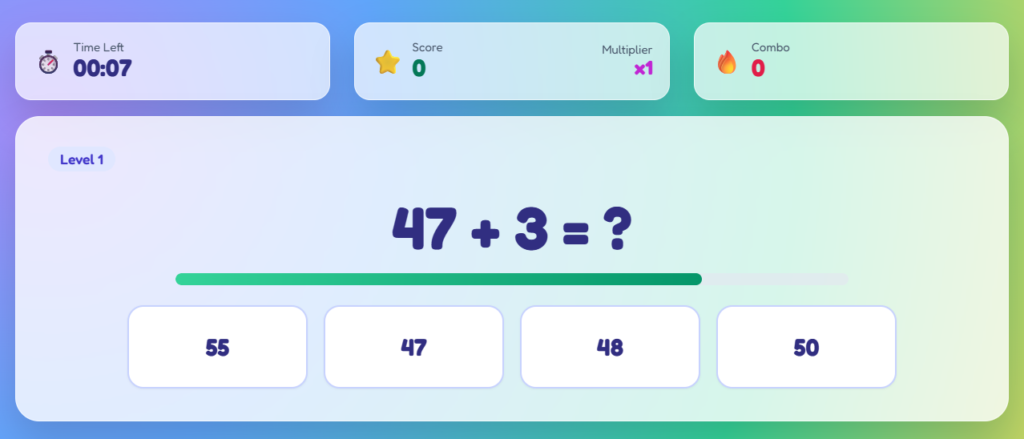
Two-digit addition with carrying gets exciting in this fast, classroom-friendly mini-game. Learners add a single digit (1–9) to larger numbers such as 34, 47, or 58, build a combo, and race a short round timer. Because each run lasts under a minute, students naturally replay, compare scores, and strengthen fluency without pressure. The layout is tuned for phones first—large tap targets, a clean 2×2 answer grid, and no horizontal scrolling—so it works equally well at home or in busy device stations.


Two-Digit Addition with Carrying: How the Game Works
Only one problem appears at a time, and learners choose from four options. Correct answers spark cheerful feedback—“Great!”, “Awesome!”, or “Amazing!”—and increase a combo that raises the score multiplier. A miss resets the combo, but the score never goes below zero. As the round progresses, the time window narrows slightly to encourage faster mental computation. Bonus questions show up at most twice per round and may award extra seconds, a burst of points, or a temporary x3 multiplier with a visible countdown badge in the HUD.
Why Short Rounds Build Fluency
Young learners benefit from quick, repeatable practice. A short round prevents overload, encourages frequent restarts, and makes growth obvious: beat your last score, extend your longest streak, or push the multiplier a little higher. Randomized answer positions remove pattern guessing, so students must actually compute. Because everything runs in the browser and stores top scores locally, the activity launches fast on school networks and older phones.
Mobile-First Details That Matter
The interface uses responsive text via clamp(), large tap targets (≥44×44 px), and GPU-friendly transforms for smooth motion. Primary actions sit in the thumb zone, and safe-area padding keeps content clear of notches and home indicators. On tablets or desktops the layout expands, but the clean look remains the same—no horizontal scrolling at any size.
Class & Home Ideas
- Warm-up: Run two quick rounds to activate prior knowledge. Ask students to explain the regrouping step aloud.
- Stations: Add the link to a device center. No typing means fast rotation and on-task time.
- Exit ticket: After instruction, replay once and record today’s best score or highest combo.
- Family practice: Share the link so families can do five-minute sessions on a phone or tablet.
Teaching Notes & Strategy Tips
Have learners check reasonableness: “If 47 + 3 = 50, does that match tens and ones?” Encourage mental shortcuts—make a ten, carry to tens, then adjust the ones. Invite students to compare two strategies after a round and reflect on which felt faster. For broad, research-based guidance around arithmetic fluency, you can review resources from the
NCTM. For more classroom-friendly mini-games, visit the internal hub at
Game4Learn.
What Learners See on the Summary Screen
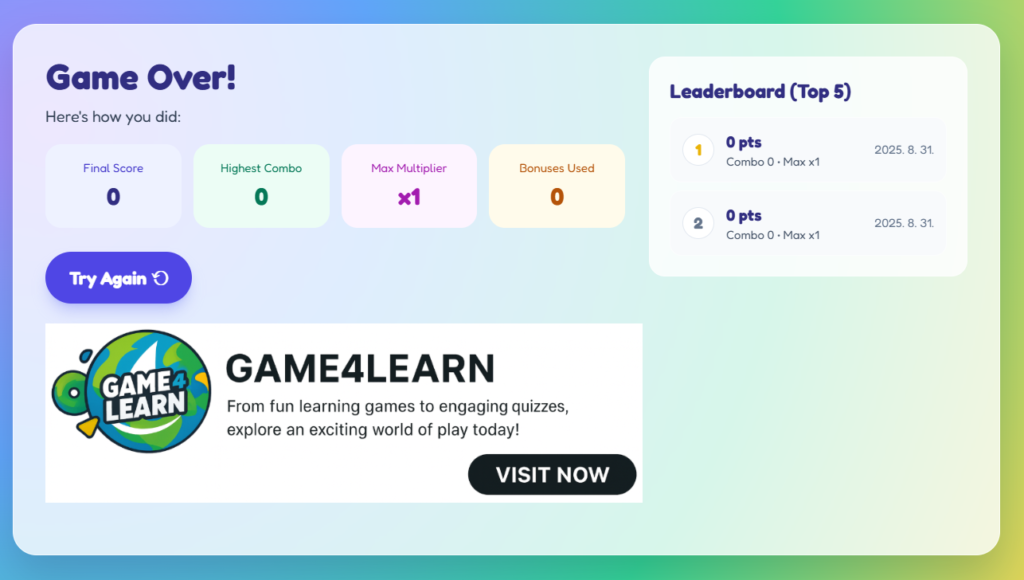
At the end of each run, the game shows the final score, the highest combo achieved, and the max multiplier. A simple Top-5 leaderboard is saved locally on the device so students can track progress over time. If they set a personal best, a shiny message—“New High Score!”—appears with a quick celebration. A large Try Again button launches another round instantly.
Why This Specific Skill Matters
Mastering two-digit addition with carrying supports later multi-digit operations and builds the foundation for mental math with regrouping. The game’s tight feedback loop—question, response, celebration, next—keeps attention on the core skill while providing just enough variety through bonuses and streaks. By combining speed with accuracy and a touch of excitement, students grow fluent without sacrificing understanding.
Two-digit addition with carrying: quick strategies that stick
When students face two-digit addition with carrying, the clearest mental path is to make a ten in the ones place and then adjust the tens. Encourage learners to say the steps out loud: add the ones, carry one to the tens, and then add the tens. Estimation helps too—before answering, ask “Should the sum be close to the next ten?” These micro-habits keep accuracy high even when the timer gets tighter near the end of a round.
How to use this game across the week
- Day 1–2: Two short runs for baseline scores. Discuss what “carry” means and model one example using base-ten language.
- Day 3: Focus on streaks. Celebrate any student who improves the combo length, not just the raw score.
- Day 4: Add reflection. Ask learners to write one sentence about a trick that made carrying faster today.
- Day 5: Friendly challenge. Use the local Top-5 board and let students try to beat their own best.
Support & differentiation
For emerging learners, reduce distractions by covering part of the screen and reading problems aloud. For fluent learners, have them explain why a distractor is wrong—this turns every question into a mini error analysis. If a student finishes early, ask them to create a similar problem on paper and solve it using the same carry steps they applied in the game.
Because the interface is mobile-first, everything works smoothly on small screens, with large tap targets and a 2×2 answer grid. Animations use lightweight transforms, so even older devices keep up. The game stores scores locally only, which makes it fast for classrooms and family practice.